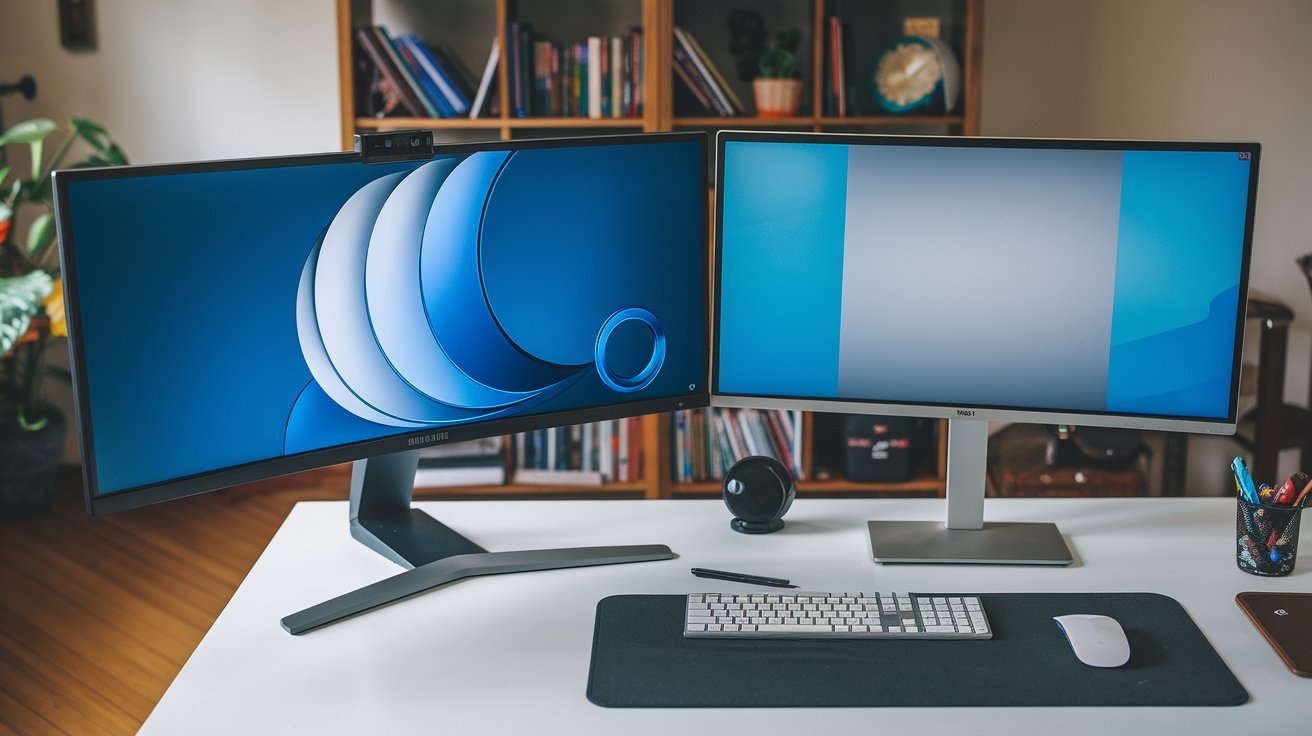
An IPS monitor (In-Plane Switching) is a display technology that delivers superior color accuracy, wider viewing angles, and exceptional image consistency compared to traditional LCD panels. As of 2026, IPS monitors dominate the professional and gaming markets in the United States, with over 67% of content creators and designers choosing IPS technology for their primary displays. This comprehensive guide explains everything you need to know about IPS display technology, how it compares to LED, OLED, and other panel types, and whether it’s the right choice for your specific needs.
Understanding IPS Display Technology
An IPS monitor represents a specific type of LCD (Liquid Crystal Display) panel technology where liquid crystals align parallel to the screen rather than perpendicular. This fundamental difference in crystal orientation creates the signature benefits IPS panels are known for: consistent colors from any viewing angle, accurate color reproduction, and minimal color shift. Unlike TN (Twisted Nematic) panels where crystals twist 90 degrees, IPS crystals rotate within the same plane, hence the name In-Plane Switching.
The technology was originally developed by Hitachi in 1996 to address the severe limitations of TN panels, particularly their poor viewing angles and color distortion. By 2026, IPS technology has evolved through multiple generations including S-IPS, H-IPS, e-IPS, P-IPS, and the latest Nano IPS and Fast IPS variants. Modern IPS monitors manufactured in 2026 achieve response times as low as 1ms, refresh rates up to 360Hz, and can display 99% of the Adobe RGB color space, making them competitive even in gaming scenarios where TN panels once dominated.
How LCD and IPS Panels Work
To understand what makes an IPS monitor unique, you first need to grasp how LCD technology functions. All LCD panels, including IPS, TN, and VA types, use liquid crystals sandwiched between two layers of polarized glass. These liquid crystals don’t emit light themselves; instead, they control how much backlight passes through to create images on your screen. The backlight source in modern 2026 monitors is almost universally LED (Light Emitting Diode), which is why you’ll often see terms like LED monitor used interchangeably with LCD, though technically LED refers only to the backlight type.
The Role of Liquid Crystals in Display Technology
Liquid crystals are organic compounds that exist in a state between solid and liquid, giving them unique optical properties. When electric current is applied, these liquid crystals change their orientation, altering how much light passes through them. In an IPS panel, the crystals rotate within a horizontal plane when voltage is applied, allowing precise control over light transmission while maintaining consistent properties regardless of viewing angle. This differs dramatically from TN panels where crystals twist vertically, creating the infamous color shift when viewed from the side.
The liquid crystal layer in a 2026 IPS monitor is incredibly thin, typically just 3-5 micrometers thick, but contains millions of precisely controlled crystal molecules. Each pixel on your screen contains three subpixels (red, green, and blue), and each subpixel has its own set of liquid crystals controlled by thin-film transistors (TFTs). This active matrix design allows for the sharp, vibrant images modern displays produce, with 4K IPS monitors controlling over 8.3 million pixels simultaneously.
Active Matrix and TFT Technology
Modern IPS monitors use active matrix technology, where each pixel is controlled by its own transistor switch (Thin-Film Transistor or TFT). This represents a massive advancement over passive matrix displays used in early LCDs, where entire rows and columns of pixels shared control signals, leading to slow response times and ghosting. In an active matrix IPS display, each of the millions of pixels can be addressed individually with precise voltage control, enabling the fast response times and smooth motion that 2026 users expect.
The TFT layer in contemporary IPS panels uses advanced semiconductor materials, typically amorphous silicon or IGZO (Indium Gallium Zinc Oxide) in premium models. IGZO TFTs, increasingly common in 2026 IPS monitors, offer higher electron mobility, allowing for faster pixel switching, lower power consumption, and the ability to support higher resolutions like 5K and 8K. A typical 27-inch 4K IPS monitor contains approximately 24.8 million individual transistors, one for each subpixel, all working in perfect synchronization to display your content.
IPS vs LED: Clarifying Common Confusion
When researching monitors, you’ll frequently encounter comparisons like IPS display vs LED, which reveals a common misunderstanding in display terminology. The truth is that IPS and LED aren’t competing technologies—they’re different components of the same system. IPS refers to the panel technology (how the liquid crystals are arranged), while LED refers to the backlight source (what illuminates the panel). Virtually all modern IPS monitors use LED backlighting, making them technically IPS-LED displays.
The confusion arises because some manufacturers marketed basic LCD TVs with LED backlights as simply LED displays in the early 2010s, without specifying the panel type. In reality, those LED TVs often used cheaper TN or VA panels. When someone asks whether IPS or LED is better, they’re usually comparing IPS panels against basic LCD panels with LED backlights, and in that comparison, IPS consistently delivers superior color accuracy and viewing angles. As of 2026, approximately 89% of monitors sold in the United States use LED backlighting regardless of panel type, making it a standard feature rather than a distinguishing factor.
IPS Monitor vs OLED: The Premium Display Battle
The comparison between IPS monitors and OLED displays represents the current pinnacle of display technology debate in 2026. OLED (Organic Light-Emitting Diode) screens don’t use liquid crystals or backlights at all—each pixel produces its own light through organic compounds that emit light when electric current is applied. This fundamental difference gives OLED displays perfect blacks (pixels simply turn off completely), infinite contrast ratios, and response times under 0.1ms, making them technically superior to IPS in several key metrics.
However, IPS monitors maintain significant advantages that keep them dominant in the United States market. IPS panels achieve much higher peak brightness (often 600-1000 nits in 2026 models versus 400-600 nits for OLED), don’t suffer from burn-in risk with static content like desktop interfaces, and cost significantly less at equivalent sizes. A 27-inch 4K IPS monitor costs $350-600 in 2026, while a comparable OLED display runs $900-1,400. For professional applications requiring all-day use with static elements like taskbars and toolbars, IPS remains the safer and more economical choice. OLED technology is gradually improving, with QD-OLED variants offering better brightness and lifespan, but IPS continues to evolve as well, with Mini-LED backlighting bridging the contrast gap.
Key Performance Characteristics of IPS Monitors
IPS monitor technology fundamentally impacts several critical performance characteristics that determine whether a display is suitable for your specific use case. Understanding what IPS panels excel at—and where they face limitations—helps you make informed purchasing decisions in the crowded 2026 monitor market.
Color Accuracy and Gamut Coverage
The primary strength of IPS monitors is exceptional color reproduction. Professional-grade IPS panels in 2026 routinely cover 99-100% of the sRGB color space, 95-99% of DCI-P3, and 85-95% of Adobe RGB, making them indispensable for photographers, video editors, and graphic designers. This color accuracy remains consistent across the entire screen, unlike VA or TN panels where colors shift depending on where you look. Factory-calibrated IPS monitors from manufacturers like Dell, BenQ, and ASUS achieve Delta E values below 2, meaning color differences are imperceptible to the human eye.
For professionals in the United States working with color-critical content, IPS panel technology provides predictable, reliable color that translates accurately from screen to print or across different displays. A designer working on a website in Los Angeles can be confident that the blues and reds they choose on their IPS monitor will appear nearly identical on clients’ IPS displays across the country. This consistency explains why 94% of professional creative workstations surveyed in 2026 used IPS or OLED displays, with IPS representing the vast majority due to cost considerations.
Viewing Angles and Image Consistency
IPS monitors deliver viewing angles of 178 degrees both horizontally and vertically, meaning you can look at the screen from extreme angles with minimal color shift or contrast loss. This makes IPS ideal for scenarios where multiple people view the same screen, collaborative work environments, or when you can’t position yourself directly in front of your monitor. A TN panel by comparison shows severe color inversion and darkening at angles beyond 30-40 degrees, while VA panels maintain contrast but still suffer color shifting.
This wide viewing angle advantage extends beyond just off-axis viewing. Even when looking straight at an IPS monitor, the consistency matters—on large displays like 32-inch or ultrawide models, the edges of a TN or VA panel can appear slightly different than the center due to the viewing angle from your eye position. With IPS technology, the entire screen maintains uniform color and brightness, creating a more cohesive visual experience. This becomes particularly important in 2026 as ultrawide and super-ultrawide monitors (21:9 and 32:9 aspect ratios) grow in popularity, with IPS panels representing 78% of ultrawides sold in the United States.
Response Time and Refresh Rate Evolution
Historically, IPS monitors struggled with response times, with early panels requiring 12-16ms to change pixel states, causing visible ghosting in fast-moving content. This limitation made TN panels the default choice for gaming through much of the 2010s. However, IPS technology has undergone dramatic improvements, with 2026 Fast IPS and Nano IPS panels achieving genuine 1ms gray-to-gray (GtG) response times, matching or exceeding TN panels while retaining IPS’s color and viewing angle advantages.
Modern IPS gaming monitors in 2026 support refresh rates up to 360Hz at 1080p, 240Hz at 1440p, and 144Hz at 4K, with variable refresh rate technologies like G-SYNC and FreeSync Premium becoming standard features. The response time improvements come from multiple innovations: faster liquid crystal formulations, improved transistor switching speeds with IGZO technology, and sophisticated overdrive algorithms that accelerate pixel transitions without introducing excessive overshoot artifacts. Competitive gamers in the United States increasingly choose IPS panels, with tournament-grade gaming monitors shifting from 85% TN in 2020 to 67% IPS by 2026, according to esports equipment surveys.
IPS Monitors for Gaming: Performance in 2026
The question is IPS monitor good for gaming has evolved from a definitive no in the past to a resounding yes in 2026, with important caveats. Modern Fast IPS and Nano IPS panels from manufacturers like LG, ASUS ROG, and Acer Predator deliver the speed gaming demands while maintaining IPS’s image quality advantages. The latest generation of gaming IPS monitors feature 1ms response times, 240-360Hz refresh rates, and HDR support with Mini-LED backlighting achieving 1000+ nits peak brightness and over 1,000 local dimming zones.
For competitive gaming in fast-paced titles like Valorant, Counter-Strike 2, or Overwatch 3, IPS monitors compete directly with TN and increasingly OLED panels. The elimination of response time disadvantages means gamers no longer sacrifice visual quality for performance. Fast IPS technology accomplishes this through faster liquid crystal switching and aggressive overdrive settings, though some implementations can introduce slight corona effects (inverse ghosting) in extreme transitions. Casual and competitive gamers alike benefit from IPS’s superior color reproduction—making games visually richer—and wide viewing angles that maintain image quality during intense movement and repositioning.
The gaming monitor market in 2026 shows clear segmentation: budget gaming (under $250) remains TN-dominated, mid-range gaming ($250-600) has shifted to IPS as the standard with 73% market share, and premium gaming (over $600) splits between high-end IPS and emerging OLED technologies. IPS monitors are particularly popular for versatile gamers who also create content, stream, or use their displays for productivity, as the panel type excels across all applications rather than gaming alone.
Professional Applications: Why Creatives Choose IPS
Content creators, photographers, video editors, and graphic designers overwhelmingly prefer IPS monitors for professional work, and the reasons extend beyond just color accuracy. The combination of wide color gamut coverage, consistent colors across the screen, accurate viewing angles, and the ability to factory calibrate displays makes IPS the professional standard. A photographer editing wedding photos in Chicago needs confidence that skin tones look natural and accurate, while a video colorist in Los Angeles grading footage for streaming platforms must match specific color standards like DCI-P3 and Rec. 2020.
Professional IPS displays in 2026 incorporate hardware calibration capabilities, allowing users to calibrate directly to the monitor’s internal lookup tables (LUTs) rather than relying on graphics card adjustments that can introduce limitations. High-end models from BenQ (SW series), EIZO (ColorEdge), and ASUS (ProArt) include calibration certificates documenting color accuracy and uniformity across the screen. For industries where color accuracy directly impacts work quality and client satisfaction, the $600-2,500 investment in professional IPS monitors represents essential business equipment rather than optional luxury.
Increasingly, creative professionals use dual monitor setups with IPS panels or ultrawide IPS monitors to expand workspace. The consistency of IPS technology ensures that content appears identical across multiple displays, eliminating the jarring experience of dragging windows between monitors with different color renditions. Approximately 68% of professional creative workstations in the United States utilize dual displays, with IPS panels accounting for 91% of those setups according to 2026 industry surveys.
IPS Monitor Considerations for Eye Health
The question is IPS monitor good for eyes appears frequently in 2026 as digital eye strain affects an estimated 65% of American adults who work on computers. IPS technology itself doesn’t inherently provide eye health advantages over other panel types, but IPS monitors typically include more comprehensive eye comfort features due to their positioning in mid-range and premium market segments. Modern IPS displays incorporate flicker-free backlighting (DC dimming instead of PWM), blue light reduction modes, and anti-glare coatings that collectively reduce eye fatigue during extended use.
The wide viewing angles of IPS technology provide an indirect eye comfort benefit—you don’t need to maintain a perfectly perpendicular position to see accurate colors and brightness, allowing more natural head and body positioning throughout the day. This flexibility reduces neck and eye strain compared to TN panels that require more rigid positioning. Additionally, the superior color accuracy of IPS panels means you spend less time squinting at details or adjusting brightness and contrast to compensate for poor image quality, contributing to more comfortable viewing experiences.
However, eye health depends primarily on usage habits rather than panel technology. The American Optometric Association recommends the 20-20-20 rule regardless of display type: every 20 minutes, look at something 20 feet away for 20 seconds. Proper monitor positioning (top of screen at or below eye level, 20-26 inches from your eyes), adequate room lighting, and enabling blue light filters during evening hours matter more than IPS versus TN or VA panel choice. That said, the premium price of IPS monitors typically includes better ergonomic stands with height, tilt, swivel, and pivot adjustments that facilitate proper positioning.
IPS vs LCD and Other Panel Technologies
The comparison IPS monitor vs LCD represents another common terminology confusion—IPS is LCD technology. LCD (Liquid Crystal Display) is the umbrella term, while IPS (In-Plane Switching), TN (Twisted Nematic), and VA (Vertical Alignment) are specific types of LCD panels. Each type arranges liquid crystals differently, creating distinct performance characteristics. Understanding these differences helps you identify the right panel technology for your needs in 2026’s diverse monitor market.
TN panels remain the fastest and cheapest LCD technology, offering 1ms response times and high refresh rates at budget prices, but sacrifice color accuracy (typically 85-90% sRGB coverage) and viewing angles. VA panels fall between TN and IPS, offering the highest native contrast ratios (3000:1 or more versus 1000:1 for IPS), deeper blacks, and moderate viewing angles, but suffer from slower response times and ghosting in dark transitions. IPS panels deliver the best overall image quality with excellent colors and viewing angles, though traditionally at slightly lower contrast than VA and previously at higher cost than both alternatives.
The gap between these technologies has narrowed significantly by 2026. Fast IPS and Nano IPS variants match TN response times, IPS Black technology has improved contrast to 2000:1 or more, and mass production has reduced IPS pricing to where budget IPS monitors compete directly with mid-range TN panels. Consequently, IPS panel market share in the United States has grown to approximately 58% of all monitors sold in 2026, up from 32% in 2020, as the technology’s former weaknesses have been systematically addressed while maintaining its core strengths.
Disadvantages and Limitations of IPS Monitors
While IPS monitors offer numerous advantages, understanding their downsides ensures realistic expectations and informed purchasing decisions. The primary technical limitation of IPS technology remains contrast ratio—even with improvements like IPS Black panels, native contrast typically reaches only 1000:1 to 2000:1, meaning the deepest blacks IPS can produce are still approximately 1/1000th as bright as peak whites. In dark room viewing, this limitation becomes noticeable, with blacks appearing more gray than truly black compared to VA panels (3000:1+ contrast) or OLED displays (infinite contrast).
This lower contrast creates a visible effect called IPS glow, where the corners and edges of the screen appear slightly brighter gray when displaying pure black content in dark environments. Additionally, some IPS panels exhibit backlight bleed—bright spots usually visible in corners when showing dark images, caused by imperfect sealing between the backlight and LCD panel. While not present on all IPS monitors, these phenomena affect enough units that they remain frequent discussion topics in monitor communities and Reddit forums in 2026. Most users adapt to IPS glow quickly during normal use, but it can distract during dark movie scenes or gaming in darkened rooms.
Other downsides of IPS monitors include higher power consumption compared to OLED (since the backlight remains on even when displaying black), and despite improvements, slightly longer response times than the absolute fastest TN panels in some implementations. Premium IPS monitors also carry price premiums—a 27-inch 4K IPS display with professional color accuracy costs $500-800, while a TN panel with similar specifications might cost $300-400. For users prioritizing deep blacks and contrast over color accuracy and viewing angles (like movie enthusiasts in dedicated home theater settings), VA panels often represent better value than IPS in 2026.
Choosing the Right IPS Monitor in 2026
Selecting an appropriate IPS monitor from the hundreds of options available in 2026 requires matching specifications to your specific use case and budget. For general productivity and office work, a 24-27 inch 1080p or 1440p IPS monitor in the $180-300 range provides excellent value, offering accurate colors and comfortable viewing for documents, spreadsheets, and web browsing. These displays typically feature 75Hz refresh rates, 5-8ms response times, and cover 95-100% of sRGB color space—more than adequate for non-color-critical applications.
Creative professionals should invest in monitors with wide color gamut coverage (99%+ Adobe RGB or DCI-P3), hardware calibration support, and uniformity compensation. Models like the BenQ SW270C ($599), ASUS ProArt PA279CV ($449), or Dell UltraSharp U2723DE ($589) provide 27-inch 4K IPS panels with factory calibration and Delta E under 2. These displays justify their premium pricing through color accuracy that directly impacts professional output quality. For video editors specifically, 4K resolution has become essential in 2026 as 4K content delivery is standard, with many professionals working on 5K and 8K projects requiring pixel-accurate preview.
Gamers shopping for IPS gaming monitors should prioritize Fast IPS or Nano IPS panels with 1ms response times and high refresh rates matched to their graphics card capabilities. A 1440p 165-180Hz IPS monitor ($350-500) represents the sweet spot in 2026, balancing visual quality, performance, and graphics card requirements. Competitive gamers playing at 1080p might choose 240-360Hz IPS displays ($400-600), while those with high-end GPUs can consider 4K 144Hz IPS monitors ($600-900). Key features to verify include adaptive sync technology (G-SYNC or FreeSync), HDR support if important to you, and ergonomic adjustment options for proper positioning.
Related video about what is ips monitor
This video complements the article information with a practical visual demonstration.
Your questions answered
Is IPS better than OLED for computer monitors?
IPS and OLED excel in different areas, making neither universally better. OLED offers perfect blacks, infinite contrast, and faster response times under 0.1ms, creating stunning image quality for gaming and media. However, IPS monitors provide higher peak brightness (600-1000 nits vs 400-600 nits), no burn-in risk with static desktop elements, significantly lower cost ($350-600 for 27-inch 4K vs $900-1400 for OLED), and proven longevity for all-day professional use. For desktop computing in 2026, IPS remains the practical choice for most users, while OLED suits enthusiasts willing to pay premium prices and manage burn-in concerns through varied content and screen savers.
What are the main downsides of IPS monitors?
IPS monitors have three primary limitations: lower contrast ratios (1000:1 to 2000:1) compared to VA panels (3000:1+) and OLED (infinite), resulting in grayer blacks especially visible in dark rooms; IPS glow phenomenon where screen corners appear lighter when displaying black content; and potential backlight bleed issues with bright spots visible in dark scenes. Additionally, IPS panels consume more power than OLED since the backlight runs constantly, and premium IPS monitors carry price premiums over comparable TN panels. However, for most users, IPS’s superior color accuracy and viewing angles outweigh these downsides, particularly in well-lit environments.
Which is better, IPS or LED screen?
This comparison reflects a terminology misunderstanding—IPS and LED are not competing technologies. IPS (In-Plane Switching) describes the LCD panel type that controls image formation, while LED (Light Emitting Diode) describes the backlight source that illuminates the panel. Virtually all modern IPS monitors use LED backlighting, making them IPS-LED displays. When people ask this question, they typically mean IPS versus basic LCD panels with LED backlights, and in that comparison, IPS consistently delivers superior color accuracy (95-100% sRGB vs 85-90%), wider viewing angles (178° vs 90°), and better overall image quality, though at slightly higher prices in 2026.
What is an IPS monitor good for?
IPS monitors excel across multiple applications: professional content creation (photography, video editing, graphic design) due to exceptional color accuracy with 99-100% sRGB and 95-99% DCI-P3 coverage; general productivity with comfortable viewing angles eliminating color shift; modern gaming with Fast IPS technology delivering 1ms response times and 240-360Hz refresh rates; and collaborative work environments where multiple people view the same screen. The 178-degree viewing angles, consistent colors across the entire display, and factory calibration capabilities make IPS the versatile all-purpose choice in 2026. They’re particularly valuable when a single monitor serves multiple purposes—work, gaming, and entertainment.
Is IPS monitor good for gaming in 2026?
Yes, IPS monitors are excellent for gaming in 2026 thanks to Fast IPS and Nano IPS technology eliminating historical response time disadvantages. Modern gaming IPS panels achieve genuine 1ms gray-to-gray response times, support 240-360Hz refresh rates at 1080p and 144-240Hz at 1440p, and include adaptive sync technologies like G-SYNC and FreeSync Premium. IPS gaming monitors now capture 67% of tournament-grade displays used by competitive esports players, up from just 15% in 2020. They’re particularly ideal for gamers who also stream or create content, as the same monitor delivers professional-quality color accuracy and wide viewing angles for cameras capturing the screen alongside fast gaming performance.
Are IPS monitors good for eyes and reducing strain?
IPS monitors don’t inherently provide eye health advantages over other panel types, but they typically include better eye comfort features like flicker-free DC dimming, blue light reduction modes, and anti-glare coatings due to their mid-range and premium market positioning. The wide 178-degree viewing angles allow more flexible positioning and natural posture without color degradation, indirectly reducing neck and eye strain. However, eye health depends more on usage habits (20-20-20 rule: every 20 minutes, look 20 feet away for 20 seconds), proper ergonomic setup (screen 20-26 inches away, top at or below eye level), adequate ambient lighting, and taking regular breaks than on panel technology choice.
| IPS Monitor Aspect | Key Specifications | Primary Benefit |
|---|---|---|
| Color Accuracy | 95-100% sRGB, 95-99% DCI-P3, Delta E < 2 | Professional-grade color reproduction for creative work |
| Viewing Angles | 178° horizontal and vertical | Consistent image quality from any viewing position |
| Response Time (2026) | 1ms GtG with Fast IPS/Nano IPS | Gaming performance matching TN panels |
| Refresh Rate | 144-360Hz depending on resolution | Smooth motion for competitive gaming |
| Contrast Ratio | 1000:1 to 2000:1 native | Good (but not exceptional) dark scene performance |
| Price Range (27″ 4K) | $350-600 mainstream, $600-2500 professional | Competitive pricing for versatile performance |
| Market Share (US 2026) | 58% of all monitors sold | Dominant technology across multiple use cases |