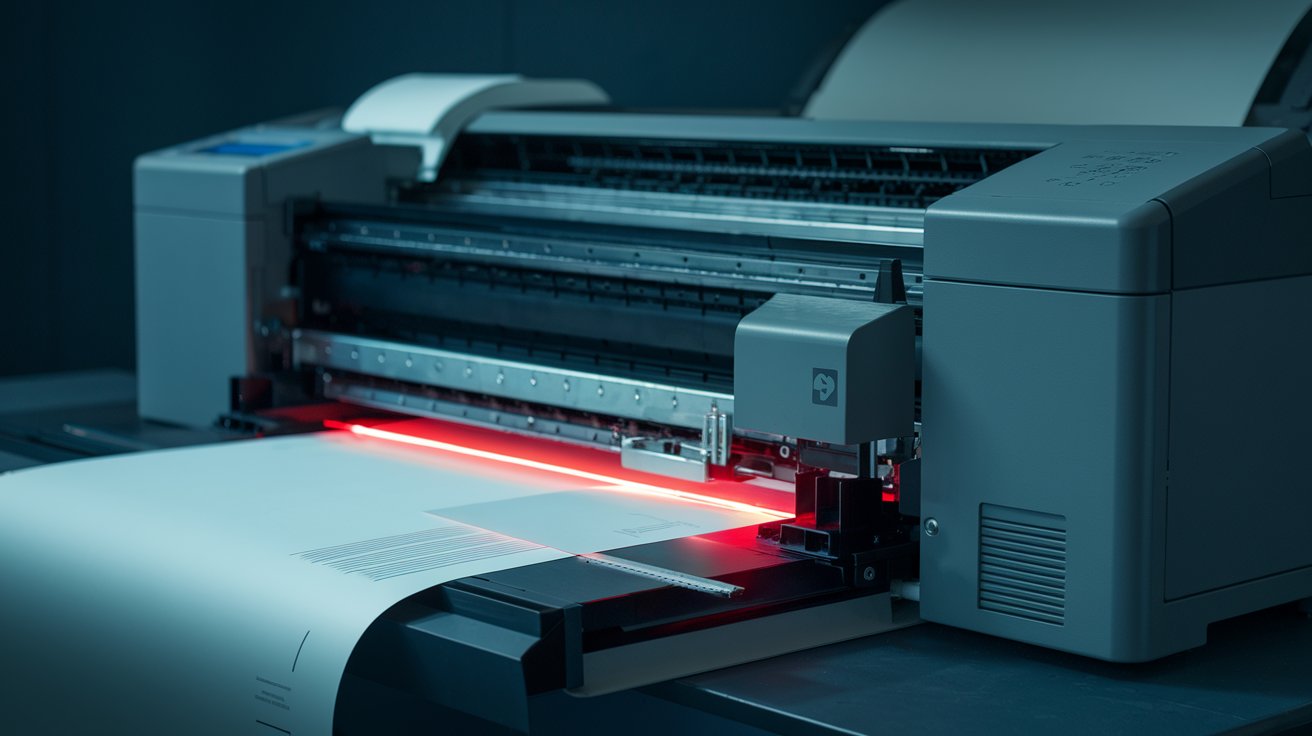
A laser printer is a high-speed printing device that uses electrostatic digital printing technology to produce text and graphics on paper. Unlike inkjet printers that spray liquid ink, laser printers use toner powder and heat to fuse images onto paper. In 2026, laser printers remain the preferred choice for businesses and home offices across the United States that need fast, cost-effective printing for documents, reports, and high-volume output.
What Is a Laser Printer in Short Answer
A laser printer is a computer printer that uses laser beam technology and powdered toner to create precise, high-quality printed documents. The printer uses a laser beam to draw the image on a photosensitive drum, which attracts toner particles. These particles are then transferred to paper and permanently fused using heat and pressure. This electrophotographic printing process enables laser printers to produce sharp text and graphics at speeds ranging from 20 to 100 pages per minute in modern 2026 models.
The technology was invented by Xerox engineer Gary Starkweather in 1969, and the first commercial laser printer was introduced in 1976. Today, laser printers dominate office environments in the United States, with over 65% of businesses choosing laser technology over inkjet for their primary printing needs due to superior speed, lower cost per page, and exceptional text quality.
How Does a Laser Printer Work
Understanding how laser printers work helps explain their efficiency and print quality advantages. The laser printing process involves seven precise steps that occur in milliseconds to produce each page.
The Seven-Step Laser Printing Process
First, the photosensitive drum receives a positive electrical charge from a corona wire or charge roller. Second, the laser beam scans across the drum surface, removing the positive charge in specific areas that match the image to be printed. Third, negatively charged toner powder is attracted to the positively charged areas on the drum. Fourth, paper receives a stronger positive charge than the drum, pulling toner from the drum onto the paper surface.
Fifth, the fuser assembly applies heat between 300-400°F and pressure to permanently bond the toner to the paper fibers. Sixth, the drum is cleaned of any remaining toner particles. Seventh, the drum charge is completely erased to prepare for the next page. This entire process happens at remarkable speeds, with 2026 models printing up to 50 pages per minute for monochrome documents.
Color Laser Printer Technology
Color laser printers use the same basic process but with four separate toner cartridges: cyan, magenta, yellow, and black (CMYK). The printer either makes four passes with a single drum or uses four separate drums and toner units working simultaneously. Modern 2026 color laser printers can produce vibrant, professional-quality color documents at speeds of 25-35 pages per minute. The color laser printing technology has advanced significantly, with better color accuracy and lower costs than previous generations, making them increasingly popular for United States small businesses.
Laser Printer vs Inkjet Printer: Key Differences
The difference between laser and inkjet printers extends beyond just the printing technology. Understanding these distinctions helps consumers and businesses make informed purchasing decisions based on their specific printing needs and usage patterns.
Technology and Print Quality Comparison
Laser printers use dry toner powder and heat fusion, while inkjet printers spray microscopic droplets of liquid ink onto paper. For text documents, laser printers produce sharper, more precise characters with cleaner edges. Inkjet printers excel at photo printing and color gradients, making them better for high-resolution image printing. In 2026, laser printer resolution typically ranges from 600×600 to 2400×600 dots per inch (DPI), which is more than sufficient for professional business documents throughout the United States market.
Speed and Volume Capabilities
Laser printers significantly outperform inkjet models in printing speed and monthly duty cycles. A typical home laser printer in 2026 prints 25-35 pages per minute compared to 10-15 pages per minute for inkjet models. Business laser printers handle monthly volumes of 2,000-80,000 pages, while inkjet printers are rated for 200-1,000 pages monthly. This makes laser technology ideal for high-volume printing environments like law offices, schools, and corporate departments across the United States.
Cost Analysis: Initial Investment vs Operating Costs
While laser printers have higher upfront costs ranging from $150 to $500 for home models in 2026, their cost per page is substantially lower. Laser printers average 2-4 cents per black page and 8-12 cents per color page, compared to inkjet costs of 5-8 cents per black page and 15-25 cents per color page. For businesses printing 500+ pages monthly, laser printers save hundreds of dollars annually in supply costs. Toner cartridges also last significantly longer, with typical yields of 1,500-10,000 pages versus 200-600 pages for inkjet cartridges.
Do Laser Printers Need Ink Cartridges
Laser printers do not use ink cartridges—this is a common misconception. Instead, they use toner cartridges containing fine powder composed of plastic particles, carbon, and coloring agents. The toner powder is electrically charged and thermally fused to paper, creating permanent prints that are smudge-proof and water-resistant immediately after printing.
Each toner cartridge contains thousands of pages worth of printing capacity. In 2026, standard toner cartridges for home laser printers yield 1,500-3,000 pages, while high-yield cartridges produce 5,000-10,000 pages. Business-grade laser printers use even larger cartridges with yields exceeding 20,000 pages. This substantial capacity makes laser printers extremely cost-effective for high-volume printing needs common in United States offices and educational institutions.
What Is a Laser Printer Used For
Laser printers serve diverse printing needs across multiple sectors. Their primary applications include business document printing, with law firms, accounting offices, and corporate departments relying on laser technology for contracts, reports, invoices, and correspondence. The sharp text quality and professional appearance make laser-printed documents ideal for client-facing materials.
Educational institutions throughout the United States use laser printers for administrative tasks, student handouts, and bulk printing of syllabi and course materials. Home offices benefit from laser printers when printing resumes, business correspondence, and tax documents. Medical offices use laser printers for patient records, prescription labels, and insurance forms. The durability of laser-printed documents makes them suitable for archival purposes, as toner-based prints resist fading for decades when stored properly. In 2026, wireless and networked laser printers enable multiple users to print from various devices, making them central to collaborative work environments.
Advantages of Laser Printers
Laser printers offer numerous benefits that justify their popularity in professional settings. The exceptional print speed ranks as the primary advantage, with modern 2026 models printing complete documents in seconds rather than minutes. Time savings accumulate significantly in busy offices where multiple employees need printing access throughout the workday.
The lower cost per page provides substantial long-term savings, especially for organizations printing thousands of pages monthly. A United States business printing 5,000 pages monthly saves approximately $500-800 annually compared to inkjet alternatives. Laser prints are immediately dry and smudge-proof, eliminating the waiting time and handling concerns associated with wet inkjet output. The superior text sharpness ensures professional document quality that reflects well on businesses and organizations.
Laser printers require minimal maintenance compared to inkjet models, with no printhead cleaning cycles or clogged nozzle issues. Toner cartridges have shelf lives of 18-24 months without drying out, unlike ink cartridges that can dry within months of opening. The reliability and duty cycle capabilities of laser printers make them dependable workhorses that perform consistently under heavy use. Network connectivity in 2026 models enables efficient sharing among multiple users, reducing the need for individual printers and lowering overall equipment costs.
Disadvantages of Laser Printers
Despite their advantages, laser printers have limitations that make them unsuitable for certain applications. The higher initial purchase price creates a barrier for casual users or households with minimal printing needs. Quality color laser printers in 2026 cost $300-800, which exceeds the budget for users printing fewer than 100 pages monthly.
Photo printing represents a significant weakness of laser technology. While laser printers produce acceptable color documents, they cannot match inkjet quality for photographs, fine art prints, or graphics requiring subtle color gradients. The toner fusion process and paper limitations prevent the photo-realistic output that specialized inkjet photo printers achieve on glossy photo paper.
Laser printers are larger and heavier than inkjet alternatives, requiring more desk space and making them difficult to relocate. A typical home laser printer weighs 20-40 pounds compared to 10-15 pounds for inkjet models. The heat generated during the fusing process means laser printers consume more electricity, with power usage ranging from 300-600 watts during active printing compared to 10-30 watts for inkjet printers. For environmentally conscious United States consumers in 2026, this higher energy consumption and the non-biodegradable nature of toner cartridges present sustainability concerns.
Types of Laser Printers
The laser printer market offers various configurations designed for different use cases and budgets. Understanding the types of laser printers available helps buyers select the optimal model for their specific requirements.
Monochrome vs Color Laser Printers
Monochrome laser printers use only black toner and are ideal for text-heavy documents, legal papers, and standard business correspondence. They offer the lowest cost per page at 2-3 cents and fastest speeds up to 50 pages per minute in 2026 models. Color laser printers add cyan, magenta, and yellow toner cartridges, enabling full-color document printing for marketing materials, presentations, and charts. While more expensive to purchase and operate, color laser printers provide professional-quality color output that inkjet printers cannot match for business documents in United States offices.
Single-Function vs All-in-One Laser Printers
Single-function laser printers focus exclusively on printing, offering the fastest speeds and lowest costs for dedicated printing tasks. All-in-one (AIO) or multifunction laser printers combine printing with scanning, copying, and often faxing capabilities in one device. The 2026 AIO laser printer market has expanded significantly, with models like the Brother MFC-L2900DW and HP LaserJet Pro MFP M428fdw offering comprehensive document management solutions. AIO models save space and provide better value for offices needing multiple functions, though they cost $100-200 more than print-only equivalents.
Best Laser Printers for Home Use in 2026
Selecting the right laser printer for home use requires balancing features, performance, and budget. The United States home laser printer market in 2026 offers excellent options at various price points, with models designed specifically for home office productivity.
The Brother DCP-L2640DW stands out as the top pick for home users, offering reliable monochrome printing at 32 pages per minute with automatic duplex printing and wireless connectivity for $179. For users needing scanning and copying capabilities, the Brother MFC-L2900DW adds an automatic document feeder and flatbed scanner for $229. These Brother models dominate recommendations due to their low operating costs, dependable performance, and compact footprints suitable for home office spaces.
Home users requiring color printing capabilities should consider the HP Color LaserJet Pro M255dw at $329 or the Brother HL-L3290CDW at $299. Both offer vibrant color output, wireless printing from smartphones and tablets, and reasonable operating costs of 8-10 cents per color page. For homes with multiple users, models with robust network connectivity and mobile printing support through Apple AirPrint and Google Cloud Print provide the flexibility modern households need in 2026.
Laser Printers for Small Business
Small businesses throughout the United States require reliable, high-capacity laser printers that can handle significant daily workloads without compromising quality or speed. The 2026 small business laser printer market emphasizes network connectivity, security features, and cost efficiency.
The Brother MFC-L3780CDW represents an excellent all-in-one color laser solution for small businesses at $499, offering 25 pages per minute color printing, advanced scanning features, and a monthly duty cycle of 4,000 pages. Its network security features and mobile device compatibility make it ideal for modern collaborative workspaces. For monochrome-focused businesses, the HP LaserJet Enterprise M507dn delivers 45 pages per minute with robust security and management features for $549.
Small businesses printing more than 3,000 pages monthly should invest in models with high-yield toner options to minimize operating costs. The Canon imageCLASS MF743Cdw offers 28 pages per minute color printing with large toner cartridges yielding 10,000 black pages and 9,500 color pages. Small legal practices, accounting firms, and medical offices benefit from AIO laser printers with automatic document feeders capable of scanning multi-page contracts and records efficiently.
Laser Printer Maintenance and Care
Proper maintenance extends laser printer lifespan and ensures consistent print quality. Regular cleaning of the paper path prevents dust and paper fragments from interfering with the printing process. Users should wipe the printer exterior monthly and clean the paper rollers every 3-6 months using a lint-free cloth slightly dampened with water.
Replacing the toner cartridge before it completely depletes prevents potential damage to the drum unit and ensures uninterrupted printing. Most 2026 laser printers provide low toner warnings through control panels or software alerts. When replacing toner, users should gently rock the new cartridge side-to-side to distribute toner evenly before installation. The drum unit typically lasts 12,000-30,000 pages depending on the model and requires periodic replacement as a normal maintenance item.
Environmental factors affect laser printer performance. Maintaining consistent temperature and humidity levels prevents paper jams and toner clumping. The ideal environment for laser printers ranges from 65-80°F with 20-80% relative humidity. Using high-quality paper designed for laser printers reduces jamming and ensures optimal print quality. United States businesses should establish a maintenance schedule that includes monthly exterior cleaning, quarterly inspection of internal components, and immediate attention to any error messages or print quality issues.
Related video about what is a laser printer
This video complements the article information with a practical visual demonstration.
Your questions answered
What are the disadvantages of a laser printer?
The main disadvantages of laser printers include higher initial purchase costs ranging from $150-800, inferior photo printing quality compared to inkjet printers, larger physical size and weight requiring more desk space, higher electricity consumption during operation, and limited ability to print on specialty media like glossy photo paper or fabric transfers. Laser printers also generate heat during use and contain non-biodegradable toner components that present environmental disposal concerns. For United States households with minimal printing needs under 100 pages monthly, the upfront investment may not justify the long-term savings.
What is the difference between inkjet and laser printers?
Inkjet printers spray liquid ink droplets onto paper, while laser printers use electrically charged toner powder fused with heat. Laser printers print significantly faster at 25-50 pages per minute versus 10-15 for inkjets, handle higher monthly volumes, and cost less per page at 2-4 cents versus 5-8 cents for black printing. Inkjet printers excel at photo printing with superior color gradients and work on diverse media types. Laser printers produce sharper text, dry instantly, and require less maintenance. In 2026, laser printers dominate United States office environments while inkjets remain popular for home photo printing.
Do laser printers need ink cartridges?
No, laser printers do not use ink cartridges. They use toner cartridges containing fine powder made of plastic particles, carbon, and coloring agents. Toner powder is electrically charged and thermally bonded to paper through heat and pressure, creating smudge-proof, water-resistant prints. A single toner cartridge yields 1,500-10,000 pages depending on capacity, far exceeding the 200-600 page yields of typical inkjet cartridges. Toner cartridges also have longer shelf lives of 18-24 months without drying out, making them more convenient for users with sporadic printing needs throughout the United States.
Which is better for home use: laser or inkjet printer?
The better choice depends on printing volume and content type. Laser printers suit home offices printing 100+ pages monthly of text documents, offering lower per-page costs, faster speeds, and sharper text quality. Families printing 500 pages monthly save $200-300 annually with laser technology. Inkjet printers better serve homes focusing on photo printing, occasional use under 50 pages monthly, or limited budgets under $100. In 2026, United States home offices increasingly prefer compact monochrome laser printers like the Brother DCP-L2640DW for document printing while maintaining a separate photo inkjet for family pictures and creative projects.
How long do laser printers last?
Quality laser printers typically last 5-10 years with proper maintenance and moderate use. Business-grade models from manufacturers like Brother, HP, and Canon often exceed 100,000 printed pages before requiring major component replacement. The drum unit, the primary wear component, lasts 12,000-30,000 pages depending on the model. Home laser printers with monthly duty cycles of 500-1,000 pages can serve reliably for 7-10 years. Regular maintenance including cleaning, using quality paper, and replacing toner before complete depletion extends lifespan. United States businesses report that well-maintained laser printers provide excellent return on investment through years of dependable service.
| Key Aspect | Important Details | Benefit |
|---|---|---|
| Print Technology | Uses laser beam and toner powder with heat fusion | Sharp text, instant drying, smudge-proof output |
| Print Speed | 25-50 pages per minute in 2026 models | Significant time savings for high-volume printing |
| Cost Efficiency | 2-4 cents per black page, toner yields 1,500-10,000 pages | Lower operating costs for businesses printing 500+ pages monthly |
| Best Use Cases | Office documents, contracts, reports, high-volume text printing | Professional quality for business applications across United States |
| Maintenance | Minimal upkeep, no printhead cleaning, long cartridge life | Reliable performance with less downtime and intervention |